
Modern financial institutions are beginning to accept a difficult reality. Adapting to regulatory change is no longer a finite project with a clear end date. Instead, it has become an ongoing, structural fact of life.
While compliance was once treated as a one-off task, it now demands the same level of strategic focus as core business functions like payroll or supplier management. As compliance complexities compound, the cost of data errors rises and scrutiny from regulators intensifies, the mandate for accurate reporting has never been more critical.
Reflections from ‘RegTech 2026: Mastering AI-driven Solutions’
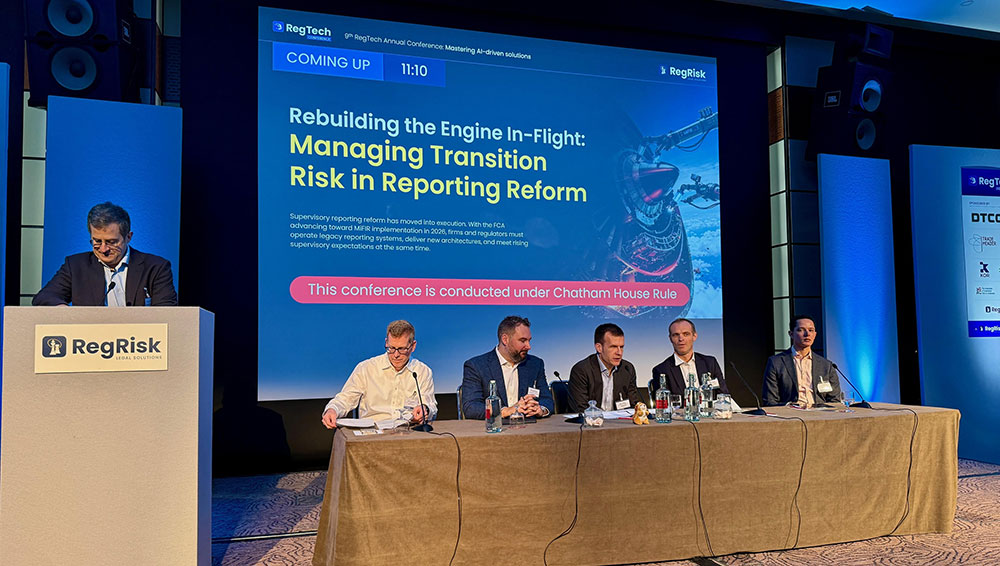
At the recent RegTech 2026: Mastering AI-driven solutions event, I had the opportunity to join a discussion titled ‘Rebuilding the Engine In-Flight: Managing Transition Risk in Reporting Reform’. The session focused on the daunting operational puzzle facing the industry today: how to modernise reporting systems without pausing daily business operations. A modern rebuild is a massive undertaking that spans execution, data, and regulatory layers. This requires transformation tools that can operate precisely alongside legacy systems which must remain live. There can be no downtime. This is the technical equivalent of attempting to rebuild an aircraft engine while the plane is mid-flight.
Breaking the scalability trap
Complexity is driven by multiple upstream trading platforms feeding into pipelines where intricate validation rules are layered across often messy and disparate architectures. We discussed how many institutions are currently caught in a scalability trap. Because their systems are often rigid, they are forced to start from zero with every new regulatory rewrite. This approach is no longer sustainable. Architecture must be built for the next wave of reforms, ensuring that the foundation is scalable and unified. By moving away from isolated project builds and transitioning toward a unified platform architecture, firms can finally break the cycle of constant, manual reconfiguration.
A mutual advantage for the ecosystem
The adoption of standards such as the Common Domain Model (CDM) and Digital Regulatory Reporting (DRR) is often framed solely as a benefit for the reporting firm. However, on the panel, we discussed how these standards create a win-win for the entire ecosystem. When financial institutions adopt standardised models, it reduces the intervention costs for vendors and service providers during integration. By simplifying the way products and events are represented, we lower the barrier for third-party tooling to work effectively within a client's specific environment. This shared efficiency helps to stabilise the industry as a whole, making it easier to absorb additional requirements from evolving regulation.

Front-loading the testing cycle
One of the most significant risks in reporting reform is that testing failures are often discovered far too late in the implementation stage. To mitigate this, firms must consider shifting the testing cycle to the very beginning of a project. By using the validation rules and checks already inherent in CDM and DRR libraries to perform testing upfront teams can identify errors much earlier- before they even reach the final reporting stage. This proactive approach reduces the likelihood of costly retrospective fixes and ensures that the technical implementation remains aligned with regulatory expectations.
Preserving institutional knowledge
A recurring challenge in the FinTech sector is the loss of institutional knowledge. As professionals move between roles or leave the industry, the original assumptions and lessons learned from previous projects, such as MiFID I and then MiFID II, are frequently lost. The panel discussed the importance of linking technical rules directly to the original decision-making processes of industry working groups. By documenting the qualitative justification for specific reporting decisions within the technical stack, firms can preserve context. This ensures that even when the original subject matter experts are no longer present, the rationale behind the reporting logic remains transparent and accessible.
Data quality as a prerequisite for AI
There is significant interest in how Large Language Models (LLMs) can parse dense regulator announcements and consultation papers to provide qualitative justification for reporting decisions. This innovative application aims to manage the heavy narrative burden of regulatory explainability. However, on the panel, we discussed a critical prerequisite: AI is not a solution for poor data. Applying advanced technology to conflicting or messy data will likely exacerbate existing architectural problems rather than solve them. The shift to a rationalised, unified architecture is what actually unlocks the potential for AI to automate processes and reduce costs.


In an age of AI, invest in humans
The smart, strategic choice for leadership is to invest in underlying architecture rather than simply expanding the headcount of operational teams to manage broken systems. But this technological shift must be accompanied by an equal commitment to people. Our panel discussed how teams must be fully educated on the new tech stack and industry taxonomies to implement these changes effectively. Even with the most sophisticated tools, the most successful firms will be those with trained personnel who understand the nuances of the technology and the relationships it governs.
Building a sustainable future
Getting this right solves a compliance headache, and also enables valuable downstream data uses, such as enhanced analytics and improved risk management. Efficiency and lower costs are achievable, provided the industry treats reporting as a core, ongoing component of its technological infrastructure. By integrating these technical and operational insights, firms can fix the engine of their plane whilst keeping it in flight, ensuring they are prepared for whatever regulatory shifts the future holds.